Thursday, June 26, 2014

Frequently Asked Questions: Why learn Hebrew through a touring program???

Why learn Hebrew while touring NYC?
Well, the question really should be “why not???

Learning a language is about communication and effective sharing of information.  It’s not about passing a test in a room with four walls.  So, if we can practice making ourselves understood anywhere, why not practice while doing something fun?!


Where does the concept of City Explorers come from?
NYC is home to many different cultural venues.  Why not take advantage of the talent and skill of the many native Hebrew speaking tour guides, restaurateurs, entrepreneurs, artists and artisans in the city?  

The sightseeing component adds an extra element of motivation to language studies and creates unforgettable location-centric memories.  


What can participants expect to learn?
We know that there are many different ways to learn a language, so we focus on strategies that can be applied to every situation and every subject.  

Participants will be surrounded by the sounds of the Hebrew language and engage in hands-on experiences during the program.  Through the lens of language exploration, participants pay attention to their brain’s efforts to make sense of information and develop tools and strategies to advance their understanding.  

Join us in stepping out of the classroom and into the great, wide, communicative world!


Who is this geared for?
City Explorers are children ages 6 -- 11 who are excited about Hebrew language and are looking for a different kind of learning experience.  Some (English) writing skills are helpful as students will have opportunities to reflect on their experiences at different points throughout the program.

All levels--from absolute beginner to native speaker--welcome and supported.


Does my child need to know any Hebrew to participate?  What if his/her Hebrew skills are rusty?  
There will be activities appropriate for different levels of Hebrew, and all will be supported throughout the program.  The games, scavenger hunts and discussions will be led by our talented Strategic Hebrew fellows who are prepared to work with mixed age and ability groups.

Don’t sweat it… we’ll give your children all the vocabulary and tools they need to enjoy the program!

They will come away with some new vocabulary, but more than that, they will have the opportunity to watch themselves figure out what to do and how to make themselves understood in this Hebrew centered environment.


What if I am a native speaker and my children are fluent?
Your children are welcome to come along and help contribute to the Hebrew atmosphere we strive to cultivate.  Of course, they won’t be stuck with the beginning language learners all day!  All activities are led by native speakers who maintain a high level of Hebrew exposure throughout the program.  

There will be activities appropriate to each conversational level, and really… who doesn’t love a trip to the zoo?


Who are the counselors?
Small groups of Explorers are led by Fellows who have taken part in the Strategic Hebrew Leaders Fellowship.  American high school students with strong language skills, Fellows have spent time studying the process of language acquisition and are prepared to guide your children through their experience.

For an in-depth look at our training program, check out our recap of the Strategic Hebrew Leaders Fellowship in 2013.  


Tell me more about the team?
Amy Fechter, Program Director, is also Curriculum Strategist at Strategic Hebrew, Inc. Winner of the 2013 Grinspoon-Steinhardt Award for Excellence in Jewish Education, Amy brings over a decade of classroom experience with students ages 3-adult.  In founding Strategic Hebrew, Amy incorporated the principles of constructivist learning from Bank Street College of Education, where she received her Masters’ Degree in Literacy.  She delights in inspiring confidence and cultivating popcorn moments among American Hebrew speakers.


Thursday, April 10, 2014

Fostering “Aha Moments”

“Well, we might as well highlight the whole page,” says one student philosophically, realizing he knew how to read and understand nearly all the Hebrew words in the מַה נִֹשְתָנָה (Four Questions asked on Passover) for the first time!


For several weeks this spring, students have listened to Hebrew children’s stories, conducted an in-depth study of  לַילָה טוֹב יָרֵחַ (Goodnight Moon) and begun to craft original short stories with the vocabulary and grammar they have learned in our JJP Hebrew Through Children’s Storybooks course.  Every session has pushed the students incrementally farther in their understanding of the Hebrew language leading up to today’s spontaneous revelation.

We were reading a pattern story about a boy’s discoveries on the road to visit his grandmother.  The end of each page posed the question: ?מַה מָצְאוּ בַּדֶרֶךְ (What did they find on the path)?


All of a sudden we heard sounds of “popcorn” popping all over the room.  
“Wait…!!!”  
“I’ve heard that word before!!!”
“Is it anything like Manishtana?”


Exactly right!  This is the moment we had been building toward all semester!


To emphasize to students the depth of their knowledge, we wrote the words of the Ma Nishtana on chart paper.  This is a song the students had been practicing for weeks in preparation for Passover.  They could read it, sing it and even explain its main themes.  However, it was clear after a few moments that they had not yet discovered how many of the Hebrew words they could actually understand on their own, by virtue of their studies in modern Hebrew literature.  


So we created a challenge:
The students were tasked with highlighting each word they could READ AND UNDERSTAND in the text (not words they kinda, sorta, like, almost got the gist of).  Then they got to work.


Word by word, students discussed whether they heard it before and what they thought it meant.  Several times, they delved into their personal dictionaries to confirm the meaning of a word they had learned in another context.  They identified prefixes, plural word endings and verb roots, applying many of the language strategies we have been practicing.  


All the while, there was such excitement and pride on their faces!  

Many were truly amazed by their own ability to read and understand the familiar yet still foreign Hebrew text.  We were so immersed in our discoveries that I forgot to take photos of the learning in action!  But you can see the final highlighted product on the left.


At the end of the class, students shared several observations about their own learning.  One student commented, “When I see Hebrew, now I try to read it… more than I did before.”  Another student added that he is “not so afraid to speak Hebrew now because I didn’t think I could do it before.” See the following journal entries for further reflections.


There is a midway point in every course where the tenor of our studies changes.  
Several things happen at once:

  • Students recognize the value of what they are learning… for it’s own sake.  
  • They begin to draw connections between the coursework and their own lives.
  • They exhibit a greater “buy in” to future lessons as a direct result of recognizing their own progress.

When, like today, the students begin to see real meaning in the prayers they encounter in their religious and family lives... these are the transformative “aha” moments that both students and teachers will treasure for a lifetime.


Tuesday, September 24, 2013

“What the world needs now are good Jewish educators” --A Holiday Reminiscence

As the season of holidays culminates with Simchat Torah this week, I cannot help but reminisce about my days in "Junior Congregation" with master educator, Leo Reich, z"l, who untangled the mystery of the Hebrew prayers and made the synagogue experience come to life in vivid technicolor. 

His dedicated leadership and obvious love of both subject and student created a strong foundation upon which I am building my own career in Jewish Education. During one of our last conversations, Mr. Reich emphasized that the world needs good, committed, Jewish educators.  His words ring in the background of my thoughts whenever I contemplate my choice of profession.

Mr. Reich was everyone’s adopted father, grandfather, and friend in the Baltimore Jewish community.  As principal of the Hebrew school and director of children’s programming for the Ner Tamid Greenspring Valley Synagogue, his soft-spoken, compelling personality drew children from all over the neighborhood specifically to hear his stories and participate in Junior Congregation.  “Uncle Leo” made each one of us feel important as members of the Jewish community and took even the most troublesome youngsters under his wing.

He also made the prayers come alive.  

Every week, Mr. Reich would conduct a search for the biggest, brightest “Ashrei smile” and give the winner a boost to show off his or her grin.  He would tell us to touch our dress clothes before we said the blessing “Malbish Arumim” (...who clothes the naked) and close our eyes to appreciate the blessing of sight before reciting “Pokeach Ivrim” (...who gives sight to the blind).  

Prayer had meaning that connected directly with my life--it encouraged me to consider gifts I never really noticed before: the ability to stand up straight, to be free and not imprisoned, to place my feet on steady, dry land.  And with Mr. Reich pointing out the meaning of a different phrase within the liturgy every Shabbat, prayer was not an exercise in rote memorization.  

We children never rushed to leave, knowing as we did that the service would be followed by sugar cookies and stories that we would treasure for years to come.  My favorite stories are those from Mr. Reich’s own army days, in which he shared memories of trying to keep Kosher while serving in a wartime army and tales of the people he met while peeling potatoes during KP duty, people whose lives he surely touched.   

Looking at Mr. Reich’s legacy, I would venture to say that the good Jewish educators the world needs are people like him, whose dedication to the calling and compassion for every person are so deeply felt by everyone nearby.

The field of education is unique in that it requires the engagement of both head and heart, intellect and emotion, and Jewish education is no exception.  The teacher’s job is to inspire and motivate the learner to further investigation and growth.  It requires sensitivity to the students' feelings and a knack for knowing when to push them to a new level of understanding and when to remain a patient and constant support.

More than personnel, it’s personality that will make the biggest difference in students’ lives, affecting the way they experience and remember the material. It is up to us, as educators, to prepare them with both the tools and the desire to continue learning even after they leave our care.  


Amy Fechter is Founder and Curriculum Strategist at Strategic Hebrew, Inc., which is creating a dynamic new approach to Hebrew language instruction through activity-based learning.  Many of the guiding principles of the *Strategic* approach derive from Leo Reich's compelling example of how to engage and inspire a commitment to Jewish learning and Hebrew language.  

Tuesday, September 3, 2013

Strategic Hebrew Leaders' Fellowship


This August, a group of talented high school students formed the first cohort of the Strategic Hebrew Leaders Fellowship.  For five days, they toured NYC attractions speaking only in Hebrew and learning about language acquisition.

The fellows came from Long Island, New Rochelle, Connecticut and as far away as Maryland to participate in this cutting edge program that encouraged them to develop strategies for improving Hebrew skills in an immersion environment.  All are leaders in their own school communities and are committed to the goal of revitalizing Hebrew language in fun settings.  

During the week, the fellows learned how to plan lessons for teaching Hebrew as a second language through sports events, museum tours and interactive games.  They became quite resourceful about using their knowledge base to express increasingly complex ideas and can now quickly assess each situation to determine what they already know and what additional tools are necessary.   As they return to school this fall, we hope their performance in all subjects will benefit from the language strategies and cognitive skills they acquired during this week. 

We were very pleased to watch the fellows gain confidence in speaking Hebrew throughout the fellowship and are proud of their dedication and commitment to making the program a success. 

Here is a brief recap of our week and what the fellows had to say about their experiences:


DAY ONE: Getting Acquainted
Ice breakers in Central Park
How do you say Gelato in Hebrew? 
 "I was proud that I could understand most of what people said to me." 

"I learned it is important to try... and to make mistakes."


DAY TWO: Movement and Daily Life
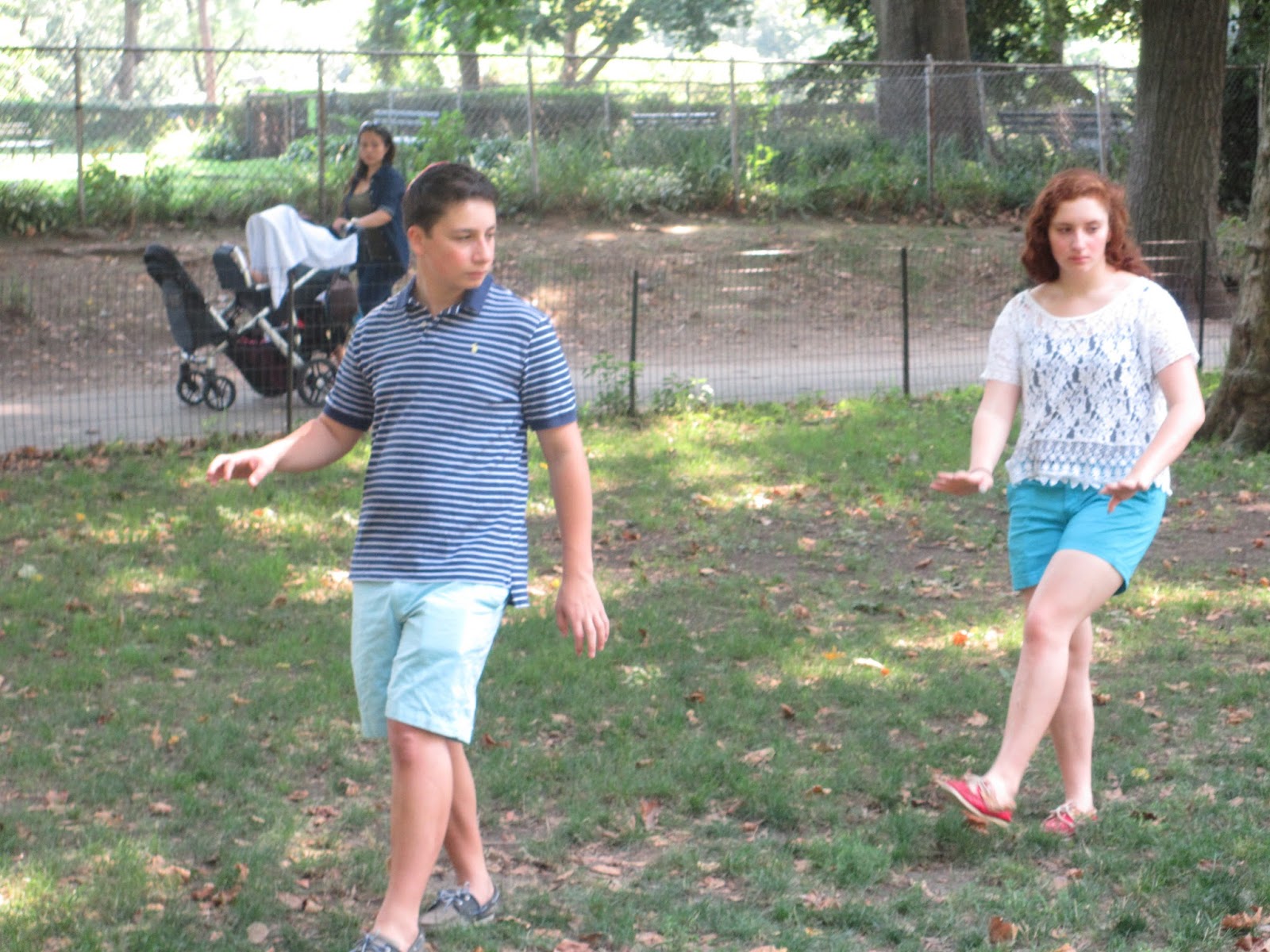
בעיטה... סיבוב... 1...2...3..
Dancing in the Park
"I learned that it helps to keep repeating new words throughout the day." 

"I learned how to say chills and goosebumps."


The ladies are at home to receive visitors... at the Merchant House Museum. 


"To learn a new language, you have to be relaxed." 

"I got used to speaking in Hebrew and not answering in English." 

"I liked the opportunity to be a tour guide at the museum." 


DAY THREE: Communication and Identity

We have a match!
Hmn... how can I explain this in Hebrew?
 "The drawing game forced me to be specific in my descriptions... or find other words to make myself understood."

"I liked speaking in Hebrew because I used new words."


Photo Scavenger Hunt in Conservatory Garden.  We have a winner!

Tracing our roots at the Jewish Museum

"It was a treat to hear a whole tour in Hebrew.  I learned lots of words I didn't know before."

"One strategy I used was listening for the context.  Then I could figure out what the main idea was." 

"It was my goal to speak more Hebrew today and I'm proud that I managed for almost the whole day."


DAY FOUR: Nature and Adaptability

Guided tour of the penguin exhibit by one of our own fellows!

The petting zoo was a rousing success.

"At the zoo, I learned how to describe animals and the names of animals I didn't know before. "

"I learned that it is important for a teacher to be flexible... and that language learning can happen anywhere."


DAY FIVE: Sustainability and Summary

Our tour of Spanish Portuguese
Synagogue was easy to understand
and a fun way to learn about Jewish
history. 
Book club in Rockerfeller Center...
Harry Potter, A Little Prince, Peter Pan,
The Wizard of Oz... what strategies
do we need to understand these classics?
"Today was a great way to sum up the program in an interactive way (especially when we ordered in Hebrew--it allowed us to see how applicable Hebrew speaking is, even where we'd least expect to use it (in a restaurant))"


And a few general reflections:

"I learned that it is better to be immersed in a language than to just study it."

"I liked the opportunity to be physically active while practicing and learning Hebrew in a fun and relaxed way."

"I learned to speak creatively in order to get my point across!"

"I learned more words in this fun, interactive way.  It's easier to remember the words because you want to learn it, not because you're in a classroom setting." 


Wednesday, July 17, 2013

How to Transform a Hebrew "Class" into an "Experience" (Strategic Principle #3)

On the anniversary of our launch one year ago, we are pleased to share a few of the successful innovations that make our classes 'strategic.' This is the third of 3 valuable tips for making Hebrew classes relevant, engaging and memorable.

1) MOTIVATION

2) LOCATION

3) APPLICATION: Learned skills are directly applied to interactive situations.

This applies to all facets of language acquisition: listening, speaking, reading and writing. Students gain knowledge and skill in order to reach a higher goal. 

What does this mean in practice?  
Here is a run-down of how each aspect of language is influenced by direct application to real life situations--the experiential approach. 

Speaking: Students use the target language to elicit a response--ask a question, receive an item, etc.   Instructors guide and assist, but ultimately, the student repeats the sentence in its entirety and is rewarded by receipt of the desired item.  


Listening: Instructions for participating in the activity are given in target language.  Students develop strategies for understanding in order to take part in the activity.   Vocabulary is introduced in context and students learn to differentiate sounds of familiar words and hear how they are used in a sentence.


Writing: Students take notes (in Hebrew characters) to keep an accessible record of what they have learned in their own handwriting, using their own systems.  Writing is purposeful, with a goal of student record keeping.  As an added bonus, writing is one indicator of language ability and can help instructors assess student progress.  


Reading: Reading skills allow students to refer to vocabulary lists and other notes when communicating ideas.  This model encourages students to pay attention to what they read; every interaction with text is infused with meaning.  Students read purposefully, with comprehension, and put their newly gained knowledge and vocabulary to use in other contexts.  


What these innovations really mean is that students learn language skills not as an end to themselves but as a means to achieving a goal.  

We need to encourage students to decode text... so that they can use what they read, not simply 'get through it.'   We need to expand our writing goals for students beyond "fill in the blank" exercises and our objective in spoken language should be more than memorization and repetition of vocabulary.  

By showing students how they can rely on each of these skills in practical application, we help motivate them to continue working toward a recognizable and achievable goal of language acquisition. 

Thursday, June 27, 2013

How to Transform a Hebrew "Class" into an "Experience" (Strategic Principle #2)

On the anniversary of our launch one year ago, we are pleased to share a few of the successful innovations that make our classes 'strategic.' This is the second of 3 valuable tips for making Hebrew classes relevant, engaging and memorable.

2) LOCATION, LOCATION, LOCATION!  Class setup is uniquely un-classroom like.  

3) APPLICATION


To take a lesson from the old adage, setting is very important. Memory scientists note that the teaching environment has a tremendous impact on whether the information will be accessible at a future time. Test taking strategists recommend that students study in the testing room if possible, so that they are more comfortable recalling their studies in pressurized surroundings.

If our mission is to help Americans gain the skills to speak Hebrew in meaningful situations, then we need to give them every opportunity to practice in a meaningful environment.  

In other words, take the class out of the classroom and learn Hebrew ON LOCATION so students can recall the vocabulary they learn next time they find themselves in a similar situation!

What does this mean for the Hebrew classes themselves?

1) Lessons are not desk and blackboard centered.  
The location of the lesson matches it's content. For example, a cooking class will take place in a kitchen, basketball class on a basketball court, and a dining class around a dinner table or inside a restaurant.

2) Location enhances motivation!
Students are excited to be on the rooftop playground, in the park or gym or supermarket. Looking around, they don't see usual evidence of school and they feel an activity is imminent. Of course, knowing that the access point to that activity is Hebrew, they pay greater attention to the introductory language lesson so they can use the new vocabulary and grammar tools to participate.

3) What about reading and writing?
A portable board or poster serves as a reference point for the language concept of the day, with vocabulary listed in Hebrew (no transliteration). Students are encouraged to use writing as a tool for recording vocabulary in their own notebooks throughout the class period, at any time they have something to record (more on this writing strategy in Strategic Principle #3)!  

Bottom line? Despite taking place in a non-traditional Hebrew classroom environment, the surroundings are print-rich and directly related to the theme of the class. All of these innovations reinforce the language and learning goals for the class and motivate students to give themselves up to the experience of learning Hebrew.


Strategic Hebrew lessons take place on basketball courts and playgrounds, in kitchens and restaurants.  The location is chosen to be conducive to the activity and students are so focused on the topic that they are fully engaged even in a lobby or other public space. View images of our classes on our website www.StrategicHebrew.com. Video footage is available on our facebook page, https://www.facebook.com/StrategicHebrew

Thursday, June 20, 2013

How to Transform a Hebrew “Class” into an “Experience” (Strategic Principle #1)

On the anniversary of our launch one year ago, we are pleased to share a few of the successful innovations that make our classes 'strategic.' This is the first of 3 valuable tips for making Hebrew classes relevant, engaging and memorable.


1) MOTIVATION: Students know what they are signing up to learn... and they want to be there!


3) APPLICATION


Whether the topic is basketball, cooking, sports, shopping, or art, students arrive with an expectation that they will get to do something they enjoy.  This intrinsic motivation will encourage them to pay attention to new vocabulary so they can use it to participate.  


Example:
During the Cooking Module at JJP, students were introduced to the terms water, sugar, lemon and mint at the beginning of our Limonana (mint lemonade) meeting.  Next, these ingredients were provided, along with cups and spoons, so students could mix the drink to their taste.  The catch?  Students had to request every item IN HEBREW!  


Student Response (journal entries):
"We made Limonana. It felt like heaven because it was a mixture of lemon juice, sugar, water... and mint. Being a person at a counter felt like a real experience in a real shop!"  
--5th Grade, Strategic Hebrew Conversation Center II at JJP


"You get to run around and then cook and eat. We learn Hebrew letters, words, verbs, nouns, adjectives, how to order and cook and have fun!"  
--4th Grade, Strategic Hebrew Conversation Center I at JJP


"Today I learned more Hebrew numbers.  We all played basketball in rotations.  If felt good to be active!"
--7th Grade, Mercaz Sicha at CRS


"Today I learned many new [Hebrew] words. I also played basketball.... I expanded my basketball vocabulary because I learned more root words.... I learned to say 'I like___,' 'I want___,' and 'I can___." In this program I was able to begin my Hebrew understanding through basketball and learn a lot of Hebrew words that will help me."  
--7th Grade, Mercaz Sicha at CRS